Mercury
Mercury is the second of the nine celestial spheres that constitute the Paradise of Dante Alighieri's Divine Comedy, a realm of light and love where the souls of the blessed are arrayed according to their earthly merits and heavenly graces. This particular heaven is the dwelling place of those spirits who, during their mortal lives, were motivated by the desire for honor and renown, achieving great deeds that brought them fame. Their presence here, in a sphere of lesser beatitude than those above, reflects the nature of their love, which, while good, was directed toward a temporal and secondary good rather than the ultimate Good of God Himself. The encounter with the soul of the Emperor Justinian, who dominates this canticle, provides a profound meditation on the providential role of the Roman Empire, the nature of justice, and the proper orientation of human ambition.
Identity and Location
Mercury is the second heaven in the Ptolemaic cosmology that structures Dante's Paradise, situated between the Moon and Venus. It is a small, luminous planet, and its appearance is described as being veiled to men by the rays of the sun, a fitting metaphor for the souls who, in life, were somewhat obscured by their pursuit of worldly glory. The pilgrim and his guide, Beatrice, ascend to this sphere with such speed that Dante is unaware of the transition, only realizing their arrival when he sees Beatrice's beauty increase, a sign of her greater joy and the heightened divine power of this realm. The souls here appear as lights within a light, their individual identities subsumed into a collective radiance that reflects their shared, yet imperfect, love.
The Encounter with Justinian
The central figure of Mercury is the soul of the Roman Emperor Justinian. He approaches Dante and, in a lengthy discourse, identifies himself and explains his presence in this sphere. Justinian recounts his own life, describing how he was a Caesar who, by the will of God, codified Roman law, removing the useless and redundant elements. He also confesses his early heretical belief that Christ had only one nature, a view corrected by Pope Agapetus I, after which he fully aligned himself with the Church. This personal history establishes Justinian as a figure who combined great worldly power and achievement with a sincere, if initially flawed, faith. His presence on Mercury is a direct consequence of his life's work, which was performed for the love of fame and the good of the empire, a good that, while divinely ordained, was not the highest good.
The History of the Roman Eagle
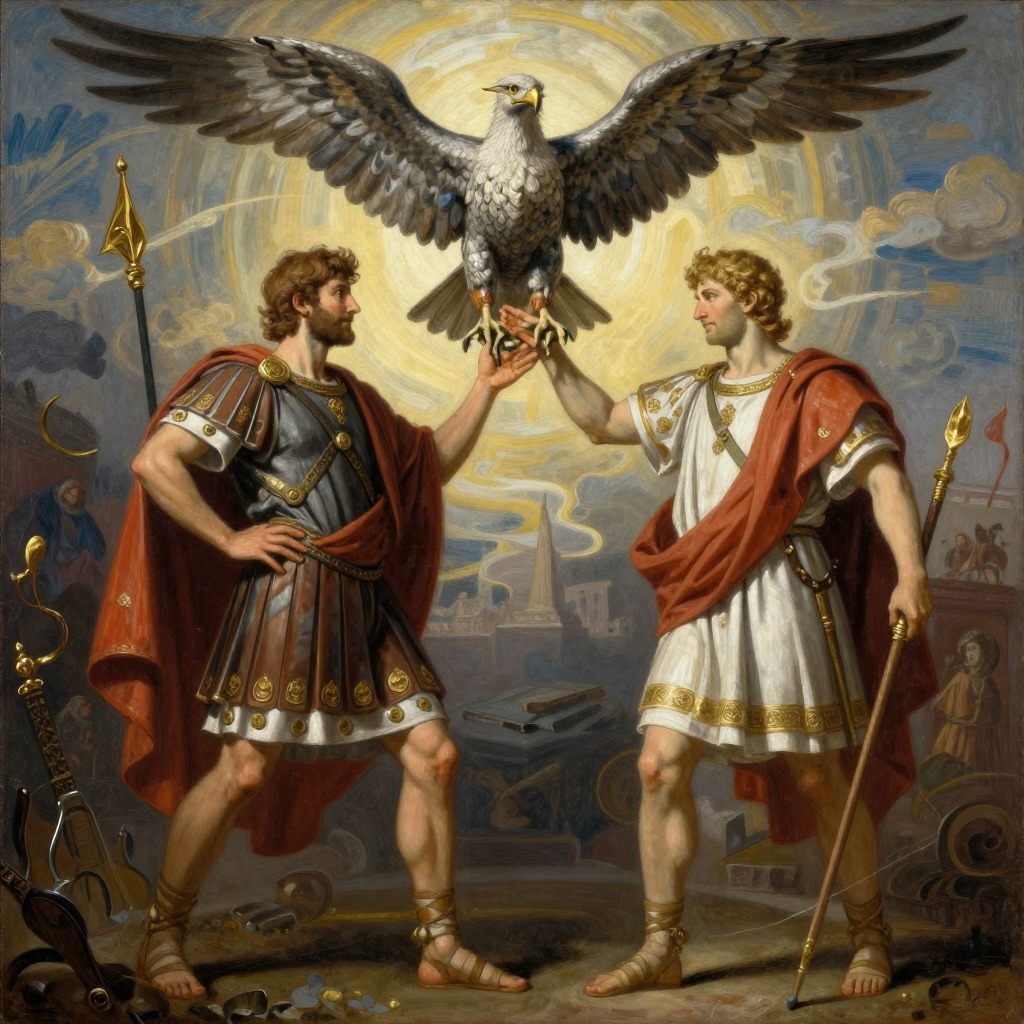
The core of Justinian's speech is a sweeping, epic history of the Roman Eagle, the imperial standard. He traces its journey from its origins in the East with Aeneas, through the founding of Rome, the Republic's wars, and the triumphs of Julius Caesar, to its role in the establishment of the Empire under Augustus. Justinian emphasizes that the Eagle's power was divinely sanctioned, culminating in its use by the Emperor Titus to avenge the crucifixion of Christ by destroying Jerusalem. He then recounts how the Eagle was later used by Charlemagne to defend the Church against the Lombards. This historical narrative serves to demonstrate that the Roman Empire was not a merely human institution but a providential instrument of God's will, a sacred standard that should not be opposed by either the Guelphs (who support the Papacy) or the Ghibellines (who support the Empire), as both factions, in their partisan struggles, profane its holy purpose.
The Nature of Fame and Justice
Justinian's discourse also clarifies the nature of the blessedness on Mercury. He explains that the souls here are content with their station, their joy being commensurate with their merit. The desire for fame, which motivated their great deeds, is not a sin but a lesser good. In Heaven, this desire is purified and satisfied, as they see that their renown is a reflection of the divine justice that rewards them. Justinian uses the example of Romeo, a humble pilgrim and steward of Raymond Berenger of Provence, to illustrate the theme of unjust reward and the ultimate justice of God. Romeo, who served faithfully and was falsely accused, died poor and in exile, but his true worth is now known in Heaven. This story serves as a warning against the fickleness of worldly fame and a comfort that divine justice will ultimately prevail, a theme that resonates deeply with Dante's own experience of exile and unjust accusation.
Thematic Significance
Mercury, as a heaven of the fame-seeking, serves a crucial thematic function in the Paradiso. It represents a stage in the soul's ascent where the love of temporal honor is transformed and reoriented toward the eternal. The souls here are not punished for their ambition; rather, their ambition is shown to be a pale reflection of the true desire for God. Justinian's history of the Roman Eagle is a powerful political and theological statement, asserting the divine right of the Empire and condemning the corruption of both Church and State in Dante's own time. The sphere of Mercury is thus a place of instruction, where the pilgrim learns that all earthly glory is fleeting and that true honor lies in aligning one's will with the divine plan, a lesson that prepares him for the higher, more purely spiritual joys of the heavens to come.